Case Study: Placemaking for Active Recreation Malta
In the case of Malta, the biggest barrier to habitual physical activity like walk ing and cycling is the lack of open spaces and supportive infrastructure that allows users to lead an active life style. The rapid urbanisation that the country has gone through over the past decades has significantly changed the landscape of the island and while smart er cities, taller buildings and wider roads were being constructed, physical activity was pushed out of daily lives.
Malta has become a concrete jungle, with public spaces favourable for physical activity, and transportation infrastructure including segregated walking and bicycle paths being noticeably absent from the country’s agenda. Instead, millions of euros are continuously invested in transportation infrastructure to accommodate the large number of cars on the is land which is growing fast er than the demographic growth.
As a result, the urban environment has become significantly hostile and incompatible with outdoor exercise and/or habitual physical activity. Local cities and villages have become car centric, posing serious danger to pedestrians and cyclists, hence discouraging the community to opt for active mobility. This is of serious concern given that Malta boasts the highest rate of obesity in children in the European Union and a third of the Maltese population is estimated to be obese by 2030. Additionally, recent studies indicate that over 500 Maltese lives are shortened annually due to air pollution.
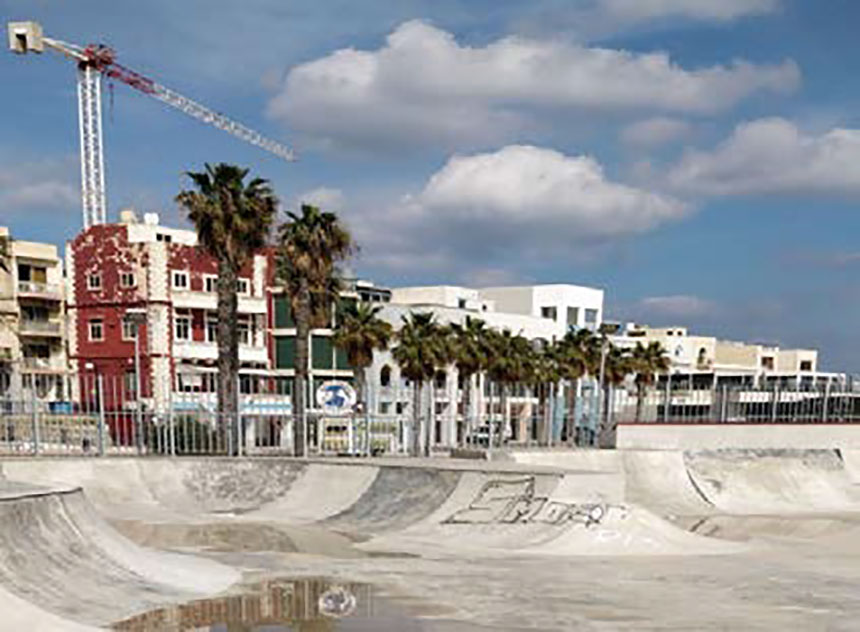
Despite the increasing awareness on the adverse effects of inactivity, to date most local approaches have focused mainly on eating behaviours while the link between the built environment, physical activity and wellbeing has received little attention. Moreover, solutions drafted by city makers to meet these challenges are not created or consulted with future users and this often results in inadequate design that does not facilitate habitual physical activity. For instance—heavy use of concrete and lack of vegetation in public spaces are not adequate for Malta’s Mediterranean weather, which is, in turn, giving rise to a number of adverse climatic conditions. Many re cent projects exhibit these negative characteristics, and some also even lack basic thinking about users of public space and transportation infrastructure – in these examples, they prioritise cars over people. How ever, there are positive examples. Take the Skate Park – Bugibba, this public space has been restored to good condition by the local community through citizen engagement. Because of the clear local interest in trans forming space to place — where a community can connect around. In contrast, a similar skate park was constructed by the local Government, but despite the lovely weather in winter, it is unusable due to heavy floods that makes the space unsafe for users.
This could have been easily avoided if the Government consulted with the users/ community, who are know ledgeable and have experience in building skateparks – they would have certainly given their input on the de sign and how to avoid the place getting flooded.
In the case of Malta, it is important to emphasise the role of the local community in the placemaking process. Given the substantial economic burden caused by lack of habitual physical activity, environmental and ecological issues like heat islands, lacking vegetation and the pressing climate change issues, interventions that encourage people to get and stay active may be attractive options from a cost-benefit perspective.